
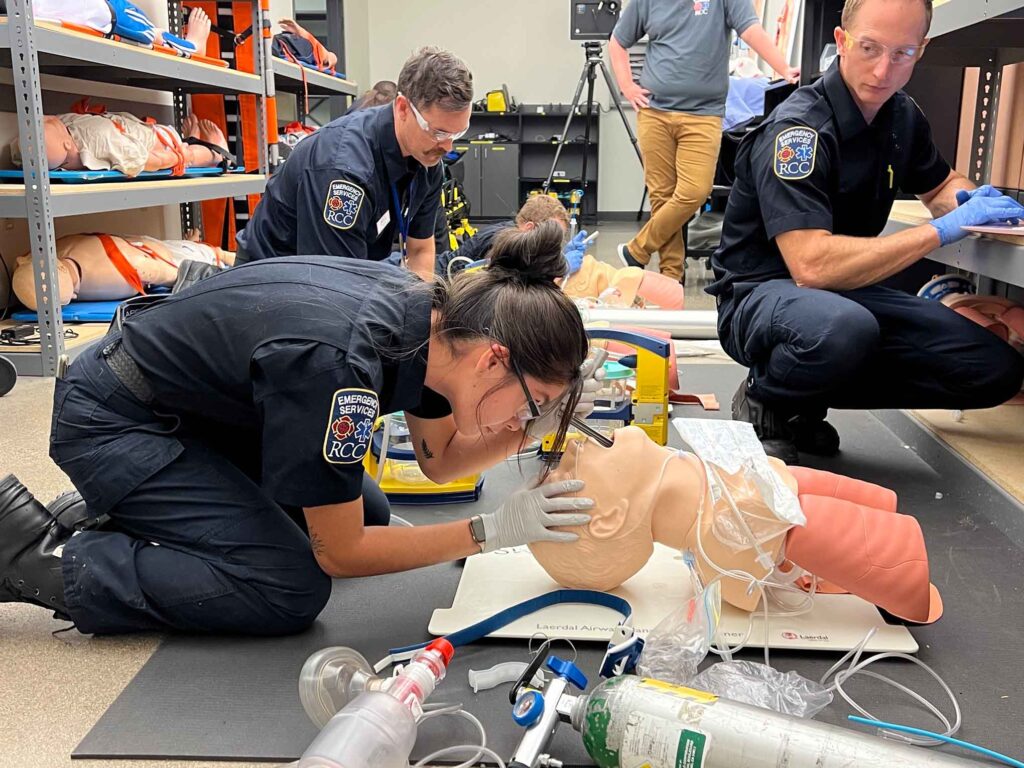
Photo/Rogue Community College
In EMS, we pride ourselves on our intubations. Any attempt to pry the laryngoscope out of our hands is met with fierce resistance. Some even see the ability to establish a definitive airway in the field as THE essential paramedic skill that defines us as a profession, and thus those skilled at intubation are seen as the most competent among us.
Despite the fact that paramedics are generally not very good at intubation,1,2 we persevere largely by use of tools such as video laryngoscopy that narrow the gap between paramedics and anesthesiologists.
What if I were to suggest that a high volume of intubations is actually a sign of poor performance? There definitely are people that need to be intubated in the field, but field intubations are also what happens when you fail to effectively treat critically ill patients.
It’s like the old joke that complicated patients become much easier to treat once they go into cardiac arrest. Likewise, going to intubation takes an otherwise complicated patient treatment scenario into a well-defined and comfortable process which is almost universally considered the “right thing to do” and good patient care.
Problems and Fixes
One thing that can lead to unnecessary intubations is a failure to recognize a deteriorating patient. These changes can be subtle. An increased work of breathing may prompt you to look at the ETCO2. A new diaphoresis may suggest that you check that blood pressure and consider pressors.
It is entirely possible to not notice your patient going downhill if you have your head buried in charting rather than reassessing. The failure is not in the intubation but in missing the opportunity to avoid it in the first place.
Here are some non-obvious things to keep in mind that may prompt early intervention:
- Keep an eye on this. It’s easy to look at blood pressure of 120/30 and think it’s okay, when it has the exact same mean arterial pressure (60) as 80/50. Early fluid resuscitation or pressor use can stabilize these patients before they become unstable.
- ETCO2 readings that don’t make sense. Do you have a high respiratory rate, but also high ETCO2? That is a sign of ventilatory failure. Likewise, low respiratory rates with low ETCO2 are very concerning for low perfusion states. As a mentor once told me, the respiratory rate and ETCO2 should never be the same number – regardless of what that number is.
- Shock index. This is so easy to calculate. If the heart rate is higher than the systolic blood pressure you have a shock index of greater than 1, and you should do something about it. Fluids and / or pressors are indicated here.
- Mental status. I like to keep a conversation going with my patients. Not because I am naturally chatty, but because it gives me an ongoing real-time insight into how their brain is working. A change in mental status should prompt immediate patient reassessment including vital signs.
- Work of Breathing. How hard is the patient working to breathe? Are there accessory muscles being used or retractions noted? If you see a patient with a strong respiratory effort start slowing down breathing and becoming exhausted, you may have a narrow window to intervene before things become much worse.
The concept of intubation as the “definitive airway” is in itself problematic. This sets it up as “the thing to do for your sick patients”. Instead consider positioning. Use CPAP / BiPAP. Use your medications to optimize perfusion. Many intubations can be avoided with early and assertive management of respiratory illnesses such as asthma.
Sometimes providers intubate for their own comfort. They want to feel like they are doing something. I will agree that having an unconscious intubated patient feels a lot better than a sick patient in distress, but whose comfort are we really treating here?
Intubation should never be a default treatment for when you don’t know what to do. It is an aggressive and invasive procedure that should only be done when it is specifically indicated. Indeed, the process of intubating a critically ill patient can worsen the patient’s condition.
When to Intubate: The Point of No Return
When it’s obvious, this decision is easy. Sometimes you walk into a call and at first glance think “I’m going to intubate that patient”. These are your unconscious and vomiting or severe trauma patients.
The decision to intubate is the hardest part of doing the skill. It can be hard to know when the right time is, and there are a lot of factors. Do I really want to intubate a patient as we pull into the ambulance bay if there is a Respiratory Therapist with a BiPAP machine right there? Maybe not.
You intubate when nothing is working. You’ve used all your non-invasive tools. They are on CPAP. Fluids and pressors are running. You’ve given nebulizer treatments and steroids. You are at the end of your respiratory protocol but their breathing is getting worse. They can’t talk anymore and their respiratory rate is slowing while ETCO2 is rising.
This is the time. Once the patient crosses a certain threshold, they aren’t going to improve and you have to breathe for them. The good news is that at this point they should be as hemodynamically optimized as they are going to get. You’ve already been pre-oxygenating them, so they should be as prepared for intubation as you could make them.
This is a big decision so as always, follow your local protocols and guidance from your medical director.
Quality Assurance
How do we find providers that are reaching for the laryngoscope too early? There are so many confounding factors. Busy systems will have more intubations per provider. Certain shifts may be more likely. And…there are certainly cases of just plain bad luck.
In an ideal world every intubation would be reviewed by clinical staff, but that is not always possible. The factors that lead to an “unnecessary” intubation may not be clearly documented by the person doing them. Again, the standard of intubation as “definitive” makes it a hard decision to challenge. The principal distinction of “avoidable” intubation should be applied.
Find out how many intubations per year your average paramedic is doing in your system and work from there. A reasonable initial filter would be two standard deviations from the mean. That would be providers who are doing more intubations than 95% of their peers. Stick these in the “bad luck” pile.
Then someone needs to really dig into these charts and see what the patient’s condition was pre-intubation, if any steps were missed in their management, and what led to the provider’s decision to intubate. These outliers are going to be a gold mine of information to drive system-wide changes.
It may be that a crew happens to start their shift at 8am (statistically the most common hour for cardiac arrest)3 in proximity to a large geriatric population. Regardless of the cause for the deviation it will be an interesting insight at a system level.
As with any QA / QI process, this should not be a punitive process. We have to assume that providers are doing their best, and any sub-optimal clinical decisions are more rooted in training gaps than malice or incompetence.
Conclusion
The culture of airway management needs to move from the traditional cowboy culture (“I got this crazy tube!”) to the more clinical (“Look how I avoided intubating this patient”). True mastery of a skill isn’t only how and when to perform it, but how and when not to.
References
1. Wang HE, Schmicker RH, Daya MR, Stephens SW, Idris AH, Carlson JN, Colella MR, Herren H, Hansen M, Richmond NJ, Puyana JCJ, Aufderheide TP, Gray RE, Gray PC, Verkest M, Owens PC, Brienza AM, Sternig KJ, May SJ, Sopko GR, Weisfeldt ML, Nichol G. Effect of a Strategy of Initial Laryngeal Tube Insertion vs Endotracheal Intubation on 72-Hour Survival in Adults With Out-of-Hospital Cardiac Arrest: A Randomized Clinical Trial. JAMA. 2018 Aug 28;320(8):769-778. doi: 10.1001/jama.2018.7044. PMID: 30167699; PMCID: PMC6583103.
2. Wang HE, Yealy DM. How many attempts are required to accomplish out-of-hospital endotracheal intubation? Acad Emerg Med. 2006 Apr;13(4):372-7. doi: 10.1197/j.aem.2005.11.001. Epub 2006 Mar 10. PMID: 16531595.
3. Tran DT, St Pierre Schneider B, McGinnis GR. Circadian Rhythms in Sudden Cardiac Arrest: A Review. Nurs Res. 2021 Jul-Aug 01;70(4):298-309. doi: 10.1097/NNR.0000000000000512. PMID: 33883500.

Pavel Aubuchon-Mendoza, AAS, NREMT-P, has been a paramedic since 2009 and is a long time paramedic field educator. He was trained in the Las Vegas EMS system and now works in the Pacific Northwest. He is a peer counselor and advocate for first responder mental health training and education.
