
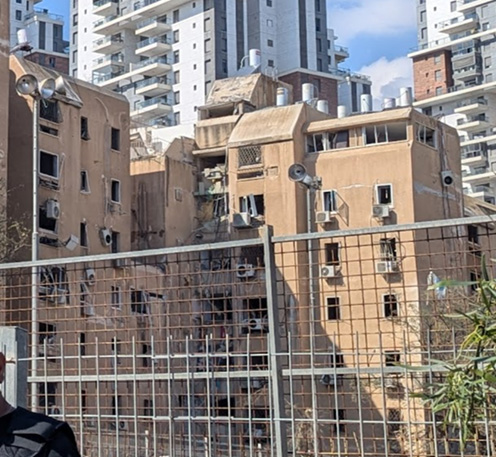
The building after it was hit by a missile. (Author photo)
By Eitan Charnoff
Abstract
On March 2, 2026, a ballistic missile launched from Iran impacted a residential courtyard in Beersheba, Israel, at approximately 12:45 pm local time, following a larger barrage that targeted multiple cities across the country.
The strike produced a multi-patient, multi-agency response that required the coordinated evacuation of roughly 2,000 affected residents from a cluster of 1970s and 1980s-era apartment buildings. This case study focuses on the most clinically complex patient encountered during that response: a 90-year-old woman with advanced chronic obstructive pulmonary disease (COPD), diabetes, non-verbal status, and permanent mechanical ventilation via tracheostomy.
She was bedridden on the second floor of a building that sustained structural damage, rendering both the elevator and the stairwell partially compromised. The case illustrates the intersection of trauma triage, ventilator-dependent patient management, and Urban Search and Rescue (USAR) extrication in a mass-casualty environment, and offers lessons relevant to any EMS system operating in a blast, collapse, or infrastructure-degraded setting.
Abbreviations
ALS: Advanced Life Support; BLS: Basic Life Support; BP: Blood Pressure; COD: Chronic Obstructive Disease; EMS: Emergency Medical Services; EMT: Emergency Medical Technician; HR: Heart Rate; MCI: Mass-Casualty Incident; MDI: Metered-Dose Inhaler; USAR: Urban Search and Rescue; SpO2: Peripheral Oxygen Saturation.
Background
Israel operates one of the world’s most rehearsed civilian emergency response architectures. Under national building codes established after the 1991 Gulf War, every residential unit constructed after that year includes a hardened mamad (safe room), while older buildings are required to maintain at a minimum one communal shelter per structure.
The country’s Home Front Command coordinates mass-notification systems, shelter protocols, and interagency response procedures that are exercised with a frequency unmatched in most Western nations.
The southern city of Beersheba has been subject to rocket and missile threats for decades, and both its civilian population and its emergency services reflect that sustained operational posture. When the March 2, 2026, barrage was detected, the city’s response architecture activated rapidly and systematically, but the scale of the attack and the density of the affected residential area generated a patient load and an evacuation challenge that tested even those well-rehearsed systems.
For EMS providers, the clinical value of this event lies not in the exceptional nature of the response but in how a specific, recurring problem set was managed under realistic field conditions: a technology-dependent patient on a floor that could not be safely served by elevator, in a stairwell that was compromised by debris, inside a building that had sustained structural damage from a munitions impact.
Incident Description
At approximately 12:40 pm on March 2, 2026, a salvo of Iranian ballistic missiles was fired toward Israeli population centers. Multiple interceptors were deployed over the Beersheba area, and several missiles were destroyed in flight.
One missile penetrated the intercept envelope and struck a courtyard surrounded by a cluster of five-to seven-story residential apartment buildings constructed in the 1970s and 1980s at approximately 12:45 pm.
The blast occurred in a shared outdoor space between buildings, directing the primary overpressure wave into the lower floors of adjacent structures and producing secondary fragmentation that shattered windows across multiple floors and for a radius of several blocks.
Because residents had received a warning and the majority had moved to shelter positions, the number of penetrating trauma and blast-injury casualties was significantly lower than an unsheltered population would have produced. The incident generated 20 patients who received medical care and transport.
Nineteen of those patients sustained light injuries, predominantly glass fragmentation lacerations consistent with a sheltered population exposed to window failure rather than direct blast. One patient, described in detail below, presented with a significantly more complex clinical and logistical profile.
Several geriatric residents required assisted extrication from upper floors before transport could be initiated. The response also initiated the forced evacuation of an estimated 2,000 affected residents while structural engineers and USAR teams assessed the integrity of the surrounding buildings.
Israel’s integrated response system had EMS, fire, police, and USAR units on scene within three minutes of the initial report. An on-scene commander assumed coordinating authority, and the activation of additional first responders was managed via radio as the incident scope was confirmed. Treatment of the walking wounded proceeded in parallel with the structural assessment and population evacuation.
I arrived at the scene at approximately 12:58 pm and was immediately directed to assist with a patient on the second floor above ground level who had sustained lacerations from shattered glass. Over the following two hours, I assisted in the assessment and evacuation of eight of the twenty patients as the broader residential population was moved out of the affected buildings.
The majority presented with lacerations from glass fragmentation requiring wound assessment and bleeding control before transport. Among those I assisted, several were elderly residents who required physical extrication support from upper floors where elevator access was unavailable or restricted.
The final patient I was involved with, and the one this case study examines in depth, was located on the second floor and represented the most clinically and logistically complex extrication of the entire response.
Patient Presentation and Scene Assessment
The patient was a 90-year-old woman with a known history of advanced chronic obstructive disease and type 2 diabetes. She was permanently non-verbal and permanently ventilator-dependent via tracheostomy. She was bedridden and had been positioned adjacent to the window in her second-floor unit at the time of the missile impact.
The first medic on scene identified lacerations to exposed skin surfaces caused by inward-traveling glass fragmentation. Bleeding control was applied as clinically indicated. The patient’s baseline vitals, once obtained, were as follows: heart rate 90 to 100 beats per minute, increasing with external stimulation and stress; SpO2 98 percent; blood pressure 140/90 mmHg; and a blood glucose reading of 277 mg/dL.
The elevated glucose was consistent with her baseline diabetic profile under stress conditions. The blood pressure was mildly elevated but not outside an expected range for a patient of her age, comorbidity profile, and circumstances. Respiratory status was maintained by the mechanical ventilator throughout.
Extrication Challenges
The second-floor location presented several compounding challenges that elevated this case above a standard evacuation.
First, the building’s elevator system was non-operational due to structural damage from the blast, eliminating the conventional vertical transport option for a bedridden patient.
Second, the stairwell servicing her floor had sustained damage and was obstructed by sporadic debris, requiring physical clearance before any patient movement could be initiated.
Third, and most clinically significant, the patient was on a permanent mechanical ventilator connected to shore power, and the attending EMT on scene was not familiar with the specific device model.
The EMT’s unfamiliarity with the ventilator was a critical decision point. The unit had an internal battery, and family members present confirmed that the device was designed to operate disconnected from electrical power.
However, without independent verification of battery status, charge duration, and disconnection sequence, the EMT made the correct clinical judgment to request ALS support before proceeding. This decision, which prioritized patient safety over expedience, is the central clinical lesson of this case.
An ALS unit arrived on scene rapidly, accompanied by a police district medical officer, providing the physician-level assessment necessary to confirm safe disconnection parameters and evaluate the patient’s overall status for transport.
The team also requested USAR support for the physical aspects of the extrication itself, given the stairwell debris and the need for a coordinated multi-person carry over a compromised surface.
As a contingency measure, the team staged a full bag-valve-mask (BVM) assembly and manual ventilation equipment at the patient’s head position prior to initiating any movement. This precaution ensured that if battery disconnection or any mechanical failure occurred during the descent, ventilation could be maintained manually without interruption.
Having that equipment positioned and ready before disconnecting from shore power, rather than staged at the ambulance or at a lower floor, reflects a straightforward but important principle of field airway management for technology-dependent patients: the contingency intervention should be within arm’s reach at the moment of highest risk.
Extrication and Transport
Once the ventilator’s battery function was verified and the team was confident in both charge capacity and disconnection protocol, the extrication began. The decision was made to carry the patient on an ambulance gurney frame rather than transfer her to a spine board.
This choice acknowledged that she had no mechanism for spinal injury warranting board immobilization, and that the discomfort and physiological disruption of an unnecessary transfer could introduce more risk than it mitigated for a patient of her age and fragility.
A USAR team physically cleared the stairwell debris in advance of the carry. The extrication team moved the patient down the flights with the attending physician and ALS provider positioned at the head, responsible for continuous ventilation monitoring and immediate BVM intervention if required. The remaining team members managed the physical carry and debris navigation.
The patient’s heart rate increased during the descent, consistent with the stress response documented in her earlier vitals, but SpO2 remained stable, and the ventilator continued to function throughout the extrication without requiring manual intervention.
She was among the last residents to be transported to the hospital from the affected complex, but she received uninterrupted monitoring and clinical oversight from the moment the first medic reached her floor, early on in the incident, through the completion of transport. There was no gap in care at any point in the timeline.
Discussion
This case offers several instructive points for EMS providers, and its lessons are not specific to a missile-strike context. They apply to any scenario in which a technology-dependent patient must be moved through a degraded environment without conventional lift access.
The first and most transferable lesson is the value of stopping to request resources rather than improvising around an unfamiliar device. The first EMT on scene correctly recognized the limits of his competence with the specific ventilator model.
Rather than attempting disconnection based on general familiarity with ventilator concepts, he held position, maintained the existing connection to shore power, and called for a provider with the clinical authority and knowledge base to make that determination safely. That decision added time to the extrication, but it eliminated the risk of inadvertent patient harm from an uninformed intervention.
This is not a failure of EMS competency. It is its expression. The ability to accurately assess the boundary of one’s own clinical knowledge and act accordingly is a fundamental professional skill, and in a high-tempo, multi-casualty environment, where the temptation to keep things moving is significant, it is not always easy to exercise.
The second lesson concerns contingency staging. Positioning the BVM and manual ventilation kit at the patient’s head before initiating any movement ensured that the team was not dependent on a mechanical system for even the few seconds it would take to retrieve backup equipment from another location.
For patients on mechanical ventilation, the contingency airway plan should be physically present and assigned to a specific provider before the patient is moved, not assumed to be available.
The third lesson involves the transport method itself. The decision to carry the patient on a gurney rather than transfer her to a backboard reflected a clinical assessment of her presentation and mechanism. She had no evidence of spinal injury. She was a fragile nonagenarian on permanent ventilation with advanced comorbidities.
The physiological cost of an unnecessary patient transfer, particularly the movement, repositioning, and potential airway disruption involved, was a greater risk than the alternative. The improvised use of the bed frame as a transport platform by a coordinated USAR team with a cleared stairwell was the right call, and it points to the broader value of having USAR assets integrated into the medical response team rather than treated as a separate operational element.
Finally, this case illustrates the operational value of Israel’s layered response architecture, specifically the speed with which a physician-level resource could be brought to a second-floor apartment in a partially structurally compromised building during an active multi-casualty event.
For EMS systems operating without that integration, the lesson is worth noting: in technology-dependent patient scenarios, the availability of physician or ALS-level judgment at the point of care is not a luxury. It is a clinical requirement.
Conclusion
The management of a ventilator-dependent, bed-ridden, nonagenarian patient during a mass-casualty missile strike response demonstrates that the most clinically complex cases in a major incident are not always the most visually dramatic.
They require methodical decision-making, honest self-assessment of provider competence, careful contingency preparation, and coordinated multi-agency execution.
The patient arrived at the hospital with stable vitals, uninterrupted ventilation, and continuous clinical coverage. That outcome was the product of a series of correct decisions made under pressure by providers who understood what they knew, what they did not know, and when to ask for help.
About the Author
management.
Exclusive feature content from thought leaders in airway management.

If this scenario seems desperate, can you imagine attempting this same rescue in Palestine? All of their Hospitals, EMS, and Fire personnel have been killed and they have no facilities for care. I would like to see how those besieged people manage with zero resources. At least Israel has EMS, military, and medical personnel to respond; not to mention the equipment to extricate patients.