
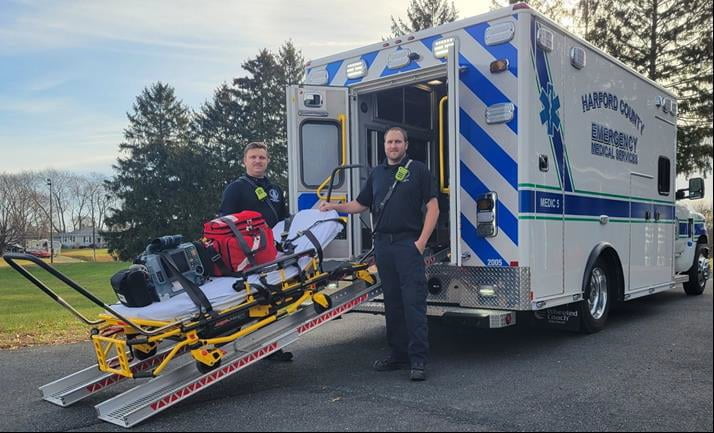
Photo/Harford County Government
The reaction to an emergency call for an unconscious/unresponsive patient can give us feelings of dread or anxiety, but when the CAD notes look like this:
- 1432: 49y/o M uncon/unresponsive, breathing.
- 433: Caller states patient 430lbs.
- 434: Additional manpower requested from second due station.
- 435: Bariatric equipment en route from Station 77.
There is a predictable groan and worsening feeling of dread because this patient who already was sick and complicated will be dramatically more so. Not only will this be complicated from a medical treatment perspective, the logistics of moving a patient of this size can be quite difficult.
However difficult it may seem to care for a bariatric patient, the difficulty is not insurmountable. Prehospital clinicians merely need to prepare for this eventuality and take deliberate steps to optimize these patients for airway management.
Bariatric Airway Challenges
Bariatric patients present with problems that require more effort to troubleshoot and overcome versus non-bariatric patients. These issues are not limited to the sheer physical difficulty of moving heavy weight around or having to use the “bigger” everything in the clinical setting.
At a baseline, without an underlying pathologic issue, bariatric patients operate near the limits of their ability to compensate for any sort of physiologic derangement. What this means for those in the prehospital world, specifically with airway management, is that these patients leave operators with very little room for error. We have to see it coming and have a response for difficulties when we encounter them.
The first class of difficulties faced by prehospital clinicians is one of physical difficulty. Their body weight greatly reduces their chest wall movement, effectively lowering their tidal volume and alveolar minute ventilation, making for poor gas exchange.
There is also a risk of a higher Mallampati score with obesity. While obesity alone is not a predictor of poor Mallampati and therefore difficulty in tube placement, neck circumference is a statistically significant predictor of airway difficulty.1-2 Neck circumference is known as the best predictor of airway difficulty in the bariatric population.1-2
Their body habitus can also make for difficult BVM ventilations. The mask seal is a critical element of delivering adequate ventilation via BVM for preoxygenation prior to intubation. For this reason, it is recommended that a two-handed, thumbs down mask seal is used in conjunction with a two-person BVM technique.1-4
The second class of difficulties that these patients present operators with are physiologic. Obesity adds weight to the chest wall that reduces pulmonary compliance. This is not a compliance issue akin to that of ARDS, but of a physical inability to move the lung tissues and fully inflate them.
This leads to another problem, reduced functional reserve capacity (FRC). In fact, it has been shown to be reduced by as much as 50%.5 The poor chest wall movement, lower tidal volume, and poor compliance contribute to poor alveolar ventilation. The result is V/Q mismatching as the lung units that are collapsed receive blood flow but are not participating in ventilation.3-5
These two issues together make for a short safe apnea period if the operator does not take the time to optimize the patient for the procedure. But the problems with oxygenation do not stop there, there is an added complication with oxygen consumption in the bariatric population.5-6
It is rare and perhaps a little unrealistic to assume that any of these issues occur in isolation in the bariatric patient. The compounding effect these issues have further narrows the safety margin for emergency airway management. What could we do to overcome these issues and tilt the odds in our favor?
Overcoming the Challenges
Airway management of bariatric patients is difficult, and can be dangerous, but it is not impossible. As the saying goes “a pound of prevention is worth an ounce of cure,” and it could not be truer in this context.
Preparation for these patients begins and ends with positioning, but it is not as simple as raising the occiput to bring the “ear to the sternal notch.” With bariatric patients, “positioning” is synonymous with “ramping.” This is literally building a ramp of blankets, pillows, or towels (for example) to create a physical ramp that elevates the patient’s chest off of the ground or bed as well as the head.
Experts suggest a 25-degree head-up, reverse Trendelenburg position.3-4,6 I do acknowledge that this is not always possible in the prehospital setting. We can approximate this by raising the head of the stretcher.
The benefits of good positioning with bariatric patients cannot be overstated. There are so many of them it could be considered reckless not to take the time to do it. By ramping the patient, the operator gains the advantage of improving lung function.
Not only is there less weight on the chest (improving the bellows function), but they now have access to the posterior lung fields for recruitment and ventilation. This position also places the glottic opening above the stomach, which negates the effect that gravity can have on gastric contents.
Finally, ramping the patient improves the view of the glottic opening with better alignment of the visual axis.1,7 This leads to faster tube placement and is associated with increased first pass success. Both of which work to improve the conditions for safe airway management.
Closing Out
When the team takes the time to prepare the patient for the procedure, it is less difficult. Taking the time to position the patient to improve preoxygenation and visualization of the glottic opening can easily overcome the known difficulties of managing the airway of bariatric patients.
It is essential that the team takes the time to prepare the patient. The operational context of prehospital emergency care does add a sense of urgency, but no patient is so sick that the team is forced to make things worse or fail altogether.
References
1. Thota B, Jan KM, Oh MW, et al. Airway management in patients with obesity. Saudi J Anaesth. 2022 Jan-Mar;16(1):76-81. doi: 10.4103/sja.sja_351_21. Epub 2022 Jan 4. PMID: 35261593; PMCID: PMC8846257.
2. Raju Vegesna AR, Al-Anee KN, Bashah MMM et al. Airway management in bariatric surgery patients, our experience in Qatar: A prospective observational cohort study. Qatar Med J. 2020 Mar 2;2020(1):2. doi: 10.5339/qmj.2020.2. PMID: 32166070; PMCID: PMC7052427.
3. Law JA, Kóvacs G. Airway management in emergencies 2E. People’s Medical Publishing House; 2017.
4. Walls RS. Manual of Emergency Airway Management 6E. Wolters Klewer; 2023.
5. Fulton R, Millar JE, Merza M. et al. High flow nasal oxygen after bariatric surgery (OXYBAR), prophylactic post-operative high flow nasal oxygen versus conventional oxygen therapy in obese patients undergoing bariatric surgery: study protocol for a randomised controlled pilot trial. Trials. 2018 Jul 27;19(1):402. doi: 10.1186/s13063-018-2777-2. PMID: 30053897; PMCID: PMC6062994.
6. Berkow LC, Sakles JC. Cases in emergency airway management. Cambridge University Press; 2015.
7. Collins JS, Lemmens HJ, Brodsky JB. Obesity and difficult intubation: where is the evidence? Anesthesiology. 2006 Mar;104(3):617; author reply 618-9. doi: 10.1097/00000542-200603000-00036. PMID: 16508416.

Cody Winniford is a flight paramedic and base manager in Baltimore, MD. He has a passion for sharing his professional experience in EMS and management. Cody’s clinical and leadership development background spans both military and civilian settings and has served in several capacities as a leader and prehospital clinician. He specializes in air medical and critical care transport, as well as organizational development and leadership development. He is an active speaker on various leadership and clinical topics and is an established and successful educator for prehospital clinicians of all levels. He has a passion for human performance improvement and the mental health and performance aspects of prehospital care.

Preparation begins and ends with positioning. You can’t do the “cool stuff” until you get the basics done! Well done Cody!