
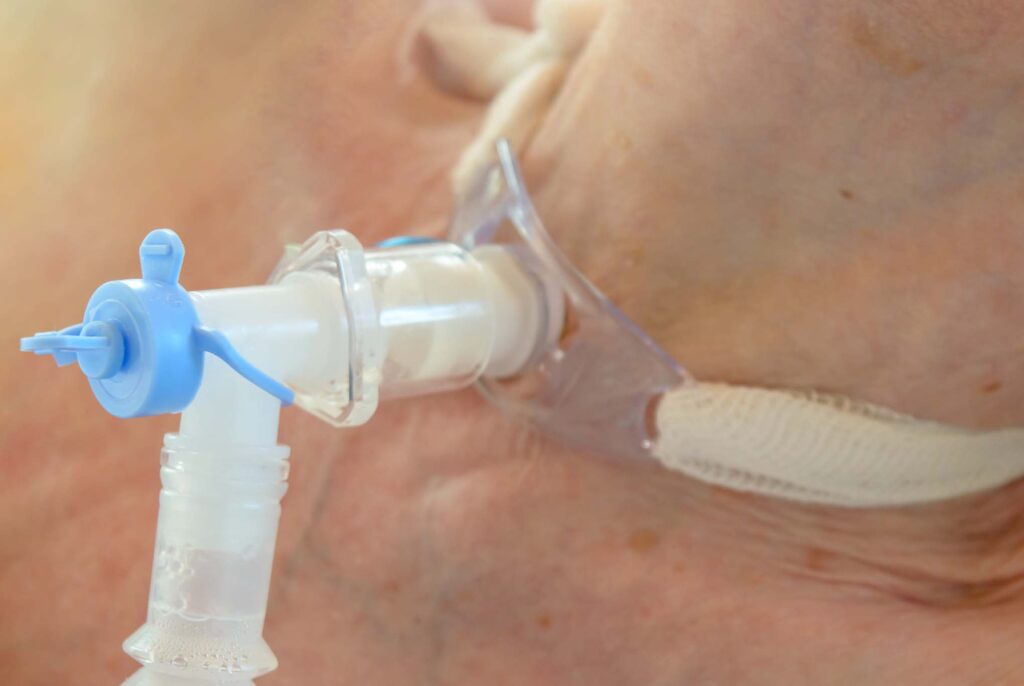
Patient with tracheostomy use ventilator for breathing. (Shutterstock/Emine Kamaci)
When EMS responds to an impending or rapidly unfolding airway catastrophe, we are typically able to correct it by providing some intervention above the vocal cords. For the most part this fixes the problem—for a short period of time. For those who require prolonged ventilator support or who need a more permanent solution to a subglottic airway problem, a tracheostomy is placed.
Interestingly, this procedure is not a marvel of modern medicine. It traces its origins back to the first documented case in 1546 when the Italian physician Antonio Brasavola performed the procedure on a patient in extremis from an abscess in the throat. There is even a story told that Alexander the Great performed the procedure with his sword to save one of his soldiers.1
The day-to-day management of a tracheostomy can be quite difficult for some patients leading to improper care and management that results in secretions that can block the tube or localized infections of the stoma itself.
When an emergency does arise, mortality is associated with failure to recognize a problem with the site, failure to troubleshoot, or a failure to respond appropriately.2 The complication rate is between 40%-50% and mortality in severe cases is near 6%.2 While not a universal truth, these cases are relatively infrequent, but clearly have devastating consequences if the team does not respond appropriately. We call these HALO events, or high acuity / low opportunity events.
Here is the math:
Dire situation + Unfamiliar/Inexperienced + No Plan = Tracheostomy Catastrophe
If the aforementioned failures are the main contributors to morbidity and mortality, then the focus should be pulling these threads (figuratively of course) so that we can appropriately troubleshoot and respond to a tracheostomy catastrophe.
Recognizing Danger and Initial Steps
The dire situation may look like most any other respiratory distress presentation: labored breathing, tachypnea, noisy breathing, accessory muscle use, agitation, and altered mental status. The initial steps are to provide supplemental oxygen and ventilate if necessary.
Troubleshooting
Tracheostomy issues are not that unlike an airway issue that we would encounter and deal with if the airway was placed above the vocal chords. Some examples of the types of issues we will need to respond to are:3
- Dislodged
- Obstructed
- Bleeding
There is one added layer of complexity, however, and that is the age of the stoma. A fresh stoma, generally somewhere between 7-14 days old, presents a more challenging and dangerous situation for the patient and the clinicians who are trying to deal with it. A fresh stoma comes with challenges such as hemorrhage and the higher likelihood of placing the tube into a false passage, if one were to attempt to replace a dislodged tube.4-6
For these reasons, a fresh stoma is approached with a high degree of caution. For the most part, it is ill advised to attempt to replace the tube and instead manage the airway above the tracheostomy. Jung notes that it is “deceptively challenging to reinsert the tracheostomy tube” back into the airway. This is due to the high risk for placement into a false passage or causing serious bleeding.4
Dislodgement / Obstruction
If the tube is not obviously displaced, simply attaching ETCo2 and looking for a waveform can ascertain tube patency.7 If adequate waveform criteria cannot be met, passing a soft suction catheter and attempting to clear and obstruction would be a logical next step.
If the catheter will not pass, it can be assumed that there is an obstruction at the distal tip of the tube and attempts should be made to clear it via suction. These obstructions can be caused by mucus plugs, blood clots, or thick secretions.
Another method of identifying an obstructed or displaced tube is to deflate the cuff and see if the patient improves. If so, the tube is either obstructed or displaced.
Another type of obstruction/displacement is a false lumen or false passage, where the tube is placed into the soft tissue anterior to the trachea. Not only is the airway no longer patent, any ventilation is being delivered into the subcutaneous tissues instead of the lungs.
When the patient presents with severe respiratory distress and subcutaneous emphysema can be appreciated, it is prudent to remove the tube and carefully attempt replacement. Note that attempting this with a fresh stoma is exponentially more difficult and dangerous than performing this on a mature stoma.5
The degree of hypoxia and respiratory distress that the patient is experiencing drives the speed and urgency of correcting these two problems. In some cases, if the patient is doing well despite tube dislodgement, then it may be prudent to defer replacement until they are at the hospital (especially if the stoma is fresh).
Hemorrhage
Life threatening bleeding secondary to the placement or presence of a tracheostomy is relatively rare, but when it does occur, it can be overwhelming. Aspiration and hemodynamic instability can quickly become devastating problems for the patient. Hemorrhage from a tracheostomy generally comes in one of two flavors depending on the age of the stoma.
Fresh stoma hemorrhage usually takes place within the first 48 hours of placement and can be attributed to several different causes. Common sources are punctured anterior jugular or inferior thyroid veins.
For older stoma hemorrhages, 4-14 days post placement, the first thought should be a trachea-innominate artery fistula. These can form from long periods of time with the tube cuff overinflated or when the tube is placed too low.5-6
Suctioning to keep the airway clear and prevent aspiration is key and essential to managing these patients. If there is significant hemorrhage and there is a cuffed tube in place, the simplest maneuver is to maximally inflate the cuff and pull toward the sternum. This will occlude the innominate artery and ideally stop the hemorrhage.5
Reestablishing Ventilation (JUNG)
The primary maneuvers for ventilating a patient with a tracheostomy are standard oral airway maneuvers (OPAs, NPAs, etc.) and ventilation with a BVM as needed. Ensure that oxygen is applied to both the mouth/nose and the stoma. If the tube is completely dislodged use a gloved hand to occlude the stoma and ventilate via the nose/mouth with a BVM.2
If the stoma is mature and replacement of the tube is logical, then it should be attempted (within the confines of local protocol or guidelines). If the original tube will not pass, use a tube that is one size smaller and attempt to pass it through the stoma and inflate the balloon. Patients generally have an emergency kit available with this tube in it, and clinicians should keep it with the patient at all times for just this type of eventuality.2
The final escalation in securing this airway is to attempt orotracheal intubation. This will be performed as usual, no modification to the standard technique is necessary. The one extra step to remember is to pass the ET tube balloon beyond the stoma before inflating the balloon and securing the tube.2
Take Home Points
While these are infrequent situations presented to us in the prehospital environment, the outcomes can be catastrophic if we respond poorly to the situation. Things to remember:
- If the patient can breathe on their own and you are providing supplemental oxygen, apply it to the nose/mouth and the stoma.
- If the patient is not breathing on their own and requires ventilatory support, you can either cover the stoma and use a BVM with BLS adjuncts/supraglottic airways to support ventilations. Another method is to use a pediatric BVM over the stoma to provide ventilation.
- If there is severe bleeding, maximally inflate the cuff and apply traction to occlude the innominate artery.
Have a plan. Practice the plan. Refine the plan.
References
1. Hektoen International. (2025, January 16). A “semi-slaughter and a scandal of surgery”: The first documented tracheostomy in history – Hektoen International. Hektoen International – An online medical humanities journal.
2. Schiff E, Ma A, Cheung T, et al. Teaching tracheostomy tube changes: comparison of operant learning versus traditional demonstration. OTO Open. 2023;7(4):e93. doi:10.1002/oto2.93
3. Graham JM, Fisher CM, Cameron TS, et al. Emergency tracheostomy management cognitive aid. Anaesth Intensive Care. 2021 May;49(3):227-231. doi: 10.1177/0310057X21989722. Epub 2021 Apr 22. PMID: 33887975; PMCID: PMC8258718.
4. Jung DTU, Grubb L, Moser CH, et al.. Implementation of an evidence-based accidental tracheostomy dislodgement bundle in a community hospital critical care unit. J Clin Nurs. 2023 Aug;32(15-16):4782-4794. doi: 10.1111/jocn.16535. Epub 2022 Oct 5. PMID: 36200145; PMCID: PMC9874912.
5. Ng J, Hohman MH, Agarwal A. Tracheostomy Tube Change. 2024 Feb 14. In: StatPearls [Internet]. Treasure Island (FL): StatPearls Publishing; 2026 Jan–. PMID: 32310379.
6. Amada H, Thornton T, Gilbert-Kawai N. Demystifying Tracheostomies. Br J Hosp Med (Lond). 2026 Jan 19;87(1):50155. doi: 10.31083/BJHM50155. PMID: 41609168.
7. Lai, Meng-Fu1; Wu, Zhi-Fu1; Lin, Chi-Yi2; Huang, Yuan-Shiou1,. Absence of Capnography from Tracheostomy: An Indicator of Tracheostomy Tube Dislodgement. Journal of Medical Sciences 39(2):p 102-104, Mar–Apr 2019. | DOI: 10.4103/jmedsci.jmedsci_134_18

Cody Winniford is a flight paramedic and base manager in Baltimore, MD. He has a passion for sharing his professional experience in EMS and management. Cody’s clinical and leadership development background spans both military and civilian settings and has served in several capacities as a leader and prehospital clinician. He specializes in air medical and critical care transport, as well as organizational development and leadership development. He is an active speaker on various leadership and clinical topics and is an established and successful educator for prehospital clinicians of all levels. He has a passion for human performance improvement and the mental health and performance aspects of prehospital care.
