
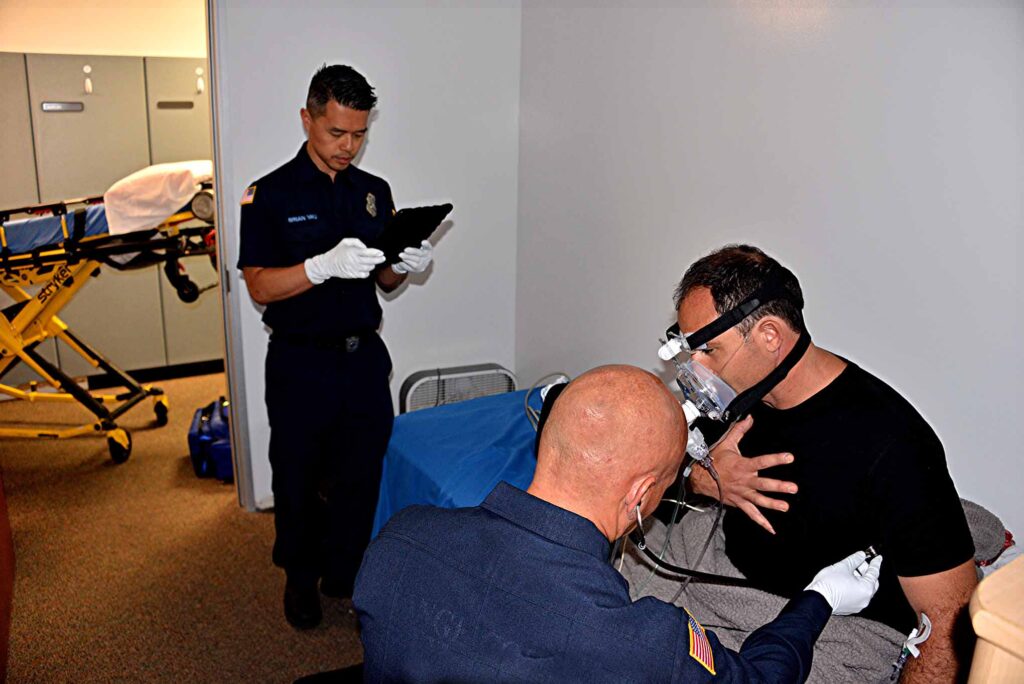
Photo/Rick McClure
By Joseph Adelman, BS, MICP
Continuous positive airway pressure, or CPAP, is one of the friendliest tools we carry in the ambulance: it straps on quickly, keeps flooded alveoli open, and almost always makes our short-of-breath patients feel better within minutes.
However, when the problem is not low oxygen but high carbon dioxide, true hypercapnia, CPAP is much less of a hero. Below is a concise, plain-English overview of the evidence that demonstrates why prehospital CPAP cannot be relied upon to lower an elevated PaCO₂ back toward normal.
A Quick Refresher—Oxygen is Not Carbon Dioxide
Hypercapnia means the blood is carrying too much carbon dioxide (PaCO₂). The fix is to breathe more (increase minute ventilation) or breathe bigger (increase tidal volume). CPAP, by design, does neither.
As Williams and colleagues put it, CPAP “maintains positive airway pressure during spontaneous ventilation throughout the whole respiratory cycle, reducing dyspnea and the work of breathing.”1
That constant pressure splints alveoli open and improves oxygen uptake, but it does not push additional air out of the lungs—and PaCO₂ leaves the body only when fresh tidal volume sweeps it away.
What Does the Field Research Actually Measure?
When researchers looked at CPAP in the back of the ambulance, they tended to track things like intubation rates, blood pressure, heart rate, and SpO₂.
In fact, the largest prehospital meta-analysis to date, which pooled five studies, found lower intubation and mortality rates for CPAP users; however, it did not report prehospital PaCO₂ at all.1
If PaCO₂ clearance had been dramatic, those numbers would almost certainly have been included in the abstract. Their absence speaks volumes.
Nigel Rees’s two-part literature review drives the point home. He notes that CPAP “resulted in significant improvements in physiological variables, need to [avoid] ETI and relief of breathlessness. Despite these benefits, they are not transferred into improved mortality.“2 More to the point, Rees highlights that “half of the patients with ACPO being admitted to hospital showed hypercapnia,” meaning the extra PaCO₂ was still there after the ride in.2
Friendly Mechanics—Why CPAP Cannot Blow Off PaCO₂
Imagine trying to empty a balloon by pressing on it from all directions at once; that is a decent analogy for CPAP and PaCO₂. What hypercapnic patients actually need is a squeeze-and-release pattern: higher inspiratory pressure to move gas in, lower expiratory pressure to let it out.
That is exactly what bilevel devices (BiPAP, BPAP S/T) and volume-targeted modes (AVAPS) provide. Gören and colleagues tested AVAPS against BPAP S/T in 80 hypercapnic patients in the emergency department and found a median drop in PaCO₂ of 10 mmHg within the first hour for AVAPS, compared to just under 5 mmHg for BPAP S/T.3
CPAP did not even make the comparison list because clinicians already know its single-pressure approach is the wrong tool for ventilatory failure.
The Missing PaCO₂ Data are Not Hidden
One reason we keep coming back empty-handed when we hunt for prehospital PaCO₂ numbers is that drawing arterial blood in the field is cumbersome, and side-stream capnography lags behind true arterial values in sick patients.
Researchers therefore pick endpoints that are easy to capture en route. That is understandable, but it also means no study has ever shown CPAP reliably lowering PaCO₂ before hospital arrival.
Rees’s earlier review even warns that most of the “improvements in physiological parameters” cited for CPAP come from in-hospital studies and “require careful critique prior to transferring these results into the prehospital setting.”4 In other words, do not let wishful thinking fill the evidence gap.
Helpful, Yes, but Mainly for Oxygen Problems
The systematic review by Williams et al. celebrates CPAP for reducing intubations and deaths in acute respiratory failure, but a closer look shows the benefit is driven by cardiogenic pulmonary edema (ACPO), where oxygenation—not ventilation—is the big issue.1
When the failing organ is the heart and the lungs are wet, splinting the alveoli with positive pressure reverses hypoxemia fast. That success story does not translate to a COPD flare with a PaCO₂ of 80 mm Hg.
Field Realities Further Limit Any Theoretical PaCO₂ Benefit
- Short treatment windows. Ambulances often spend less than 15 minutes on scene and maybe another 10 to 20 minutes on the road. In contrast, the in-hospital CPAP trials that showed modest PaCO₂ falls delivered an hour or more of therapy before checking an arterial blood gas. We simply do not stay in prehospital care for that long.
- Single-pressure gear. Most EMS CPAP kits are oxygen-driven, disposable systems with a fixed expiratory valve and no inspiratory boost. They are rugged and cheap, but they are not ventilators.
- Mask comedy. Hypercapnic patients are often drowsy or downright combative; straps slip, air leaks and therapy pauses every time the patient pulls the mask to talk or vomit. Rees documents minor yet disruptive events like vomiting and mask intolerance in CPAP trials.2
What About Safety? Could CPAP at Least be Harmless?
CPAP is generally well-tolerated, but it is not a free lunch. The same positive pressure that lifts oxygen levels can decrease venous return, drop blood pressure, and distend the stomach.
In Rees’s summary of adverse events, two CPAP patients vomited, and others experienced mask issues—nothing catastrophic, yet enough to interrupt therapy and further reduce any chance of clearing PaCO₂ before the ED doors slide open.2
Comparative Modes Show the Direction We Need to Head
The AVAPS-versus-BPAP trial provides a nice sanity check. Both modes supply inspiratory support, and both lowered PaCO₂; AVAPS just did it a bit faster.3
That finding reminds us that removing PaCO₂ is quite possible when the machine actually assists ventilation. CPAP, lacking that assistance predictably falls short.
Pulling the Threads Together
- Hypercapnia equals insufficient ventilation.
- CPAP adds no inspiratory pressure, so it cannot boost ventilation.
- Field studies track oxygen‐centered endpoints and leave PaCO₂ unreported—because it does not change meaningfully.
- Reviews note persistent hypercapnia on hospital arrival even after prehospital CPAP.
- Modes designed to ventilate (BPAP, AVAPS) do lower PaCO₂.
- Real-world constraints—brief transport times, simple equipment, and imperfect seals—further undercut any theoretical PaCO₂ benefit from CPAP.
So, What Should Medics Do When the ETCO₂ is Climbing?
If your service carries a true bilevel ventilator, break it out early for COPD exacerbations, obesity hypoventilation, or any case where PaCO₂ narcosis is the worry.
If you only have CPAP, use it for cardiogenic pulmonary edema and severe hypoxemia, but temper expectations for hypercapnic patients and transport promptly to definitive care. Better still, advocate for service-level protocols that put inspiratory-assist devices on the trucks.
Wrapping Up
CPAP is a terrific oxygenation aid and a morale booster for patients gasping with wet lungs. Yet, friendly as it is, CPAP cannot be trusted to blow off carbon-dioxide in the prehospital environment.
Until future research proves otherwise, treating hypercapnia in the field means moving beyond single-pressure masks and embracing proper pressure-support modes or getting the patient to a place that can.
About the Author
Joseph Adelman is a retired fire service professional with 25 years of dedicated service and now works as a 911 paramedic in suburban New Jersey. He and his amazing wife share three grown daughters and their spouses, along with eight wonderful grandchildren who brighten their lives every day. Committed to lifelong learning, Joe is currently pursuing an MBA in health care management to deepen his expertise and drive positive change in emergency medical services.
References
1. Williams, T. A., Finn, J., Perkins, G. D., & Jacobs, I. G. (2013). Prehospital continuous positive airway pressure for acute respiratory failure: A systematic review and meta-analysis. Prehospital Emergency Care, 17(2), 261-273.
2. Rees, N. (2010b). Prehospital continuous positive airway pressure ventilation in acute cardiogenic pulmonary edema: Part 2. Journal of Paramedic Practice, 3(4), 179-185.
3. Gören, N. Z., Şancı, E., Ercan Coşkun, F. F., Gürsoylu, D., & Bayram, B. (2021). Comparison of BPAP S/T and average volume-assured pressure support modes for hypercapnic respiratory failure in the emergency department: A randomized controlled trial. Balkan Medical Journal, 38(5), 265-271.
4. Rees, N. (2010a). Prehospital continuous positive airway pressure ventilation in acute cardiogenic pulmonary edema: Part 1. Journal of Paramedic Practice, 3(3), 129-134.
Exclusive feature content from thought leaders in airway management.
