
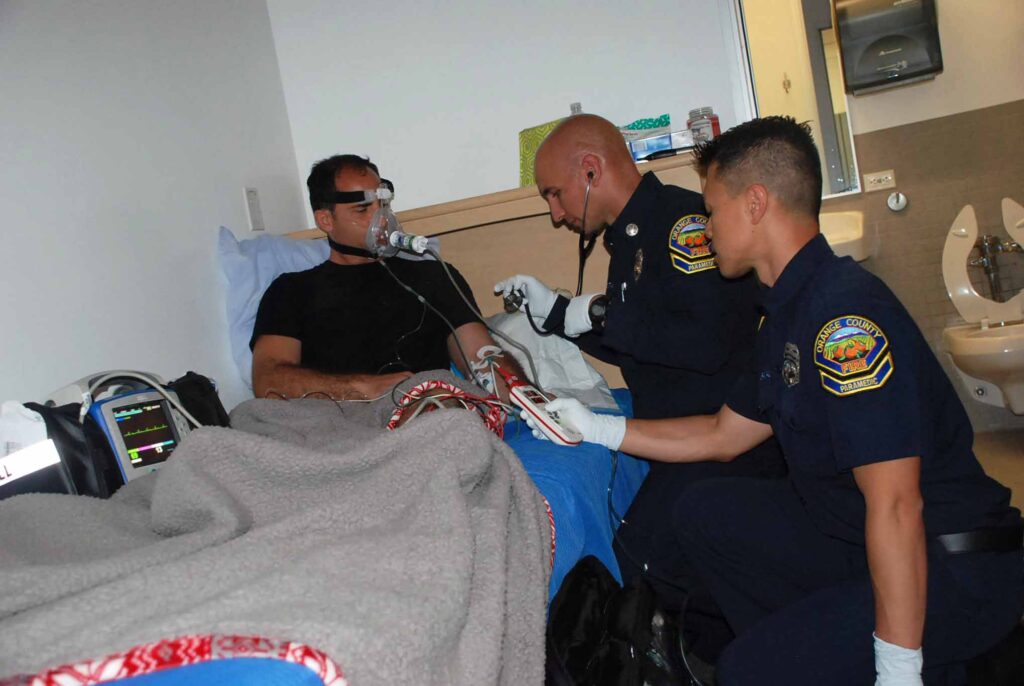
EMS Airway File Photo
Part I of this series is the reminder we sometimes need. This second article focuses on practical field performance—patient selection, setup, oxygen strategy, troubleshooting, and clear escalation thresholds—so CPAP delivers its best possible value before you hit the ambulance bay.
CPAP Quick Start
- Pick the right physiology: strongest payoff in acute cardiogenic pulmonary edema and hypoxemic respiratory failure.1,2
- Coach first: “It’s loud and tight. Slow in, long out. Give it 60 seconds.”
- Start low and titrate begin around 5 cm H₂O equivalent, then increase toward 10 if distress persists and blood pressure tolerates it.
- Seal check in three spots: bridge of nose, cheeks, and under the chin. Fix leaks before changing the plan.
- Reassess quickly: at 2–3 minutes (seal/tolerance), 5 minutes (work of breathing trend), and 10 minutes (continue vs escalate).
References: 1,2,3,4
1) Indications that pay off: oxygenation failure and wet lungs
In the prehospital environment, CPAP performs best when the primary problem is oxygenation failure with recruitable alveoli—not primary ventilatory failure. That is why acute cardiogenic pulmonary edema remains CPAP’s most consistent win. Prehospital syntheses associate CPAP/NIV with reduced intubation rates compared with standard oxygen therapy, and some analyses also suggest mortality benefit in selected populations.1,2,3
2) The CPAP clock: start early, reassess aggressively
Timing is a major mechanism of benefit: earlier positive pressure can reduce fatigue, stabilize gas exchange, and prevent the late crash that forces airway control. The field advantage disappears when CPAP is delayed until after prolonged high-flow oxygen and repeated deterioration.2,4
3) Pressure is a dose: titrate with intent
Think of CPAP pressure like a medication dose. Start at a tolerable setting and escalate only if the patient is still working hard to breathe and hemodynamics allow. If blood pressure drops or the patient cannot tolerate the interface, reduce the dose, or switch strategies.4
4) The oxygen trap: avoid over-oxygenation in COPD
In patients with COPD or suspected CO₂ retention, high-flow oxygen can worsen hypercapnia and acidosis. A randomized prehospital trial found titrated oxygen reduced mortality and hypercapnia compared with high-flow oxygen in COPD exacerbations.5 Oxygen guidance recommends targeting normal or near-normal saturations for most patients but using lower target ranges for those at risk of hypercapnic respiratory failure.6
Oxygen Targets in COPD
- If COPD (or CO₂ retention risk) is likely, avoid “blast oxygen until 100%.”
- Aim for a target SpO₂ range (often 88–92% in CO₂ retainers per oxygen guidance).
- If SpO₂ climbs above target after CPAP starts, down-titrate oxygen delivery if your device/system allows.
- Trend mental status and ventilatory effort; rising somnolence is not a victory lap.
References: 5,6,7
5) Seal is everything: troubleshoot before you declare failure
A large fraction of apparent CPAP “failures” are actually delivery failures—leaks, poor mask fit, or constant interruptions. Bench testing shows meaningful performance differences across CPAP devices and setups.8 Before you abandon CPAP, confirm an effective seal, stable pressure delivery, and that the patient has been coached to breathe with the device.
6) Know when CPAP is failing define failure up front
CPAP should not become a ritual. Build explicit stop/upgrade criteria into the protocol and teach crews to reassess in short cycles. NAEMSP emphasizes that medical directors must ensure training in patient selection, system operation, adjunct medications, and assessment of response, supported by QA/QI.4 When ventilatory failure is the dominant problem, professional society guidance supports bilevel NIV for acute hypercapnic COPD exacerbations.7
CPAP Failure Criteria
- Worsening mental status, inability to protect airway, or repeated vomiting.
- Refractory hypoxemia despite optimized seal and appropriate pressure.
- No meaningful improvement in work of breathing after a brief trial (e.g., 5–10 minutes).
- Hemodynamic instability plausibly worsened by positive pressure.
- Intolerance that cannot be corrected with coaching and interface adjustments.
Operational guidance: 4,7
7) System pearls: training, BLS use, and quality improvement
Prehospital CPAP success is largely a system-design issue. Evidence syntheses support reduced intubation risk with early prehospital CPAP/NIV compared with standard care, but outcomes depend on training, device performance, and disciplined reassessment.1,2,3 NAEMSP explicitly supports EMT use of NIV when supported by training and medical oversight.4 Track simple program metrics such as time-to-CPAP, documented seal troubleshooting, pre/post RR and SpO₂, and escalation decisions.
8) Anxiety, Interface Intolerance, and the Role of Judicious Anxiolysis
Patient intolerance driven by anxiety, claustrophobia, or air hunger is a common and often reversible cause of prehospital CPAP failure. While coaching and interface adjustments remain first-line interventions, selected patients may benefit from carefully titrated anxiolytic medication to improve tolerance and avert premature CPAP abandonment.4,7
Low-dose benzodiazepines such as midazolam may be considered alert patients with intact airway reflexes whose CPAP intolerance is anxiety-driven rather than physiologic failure. The intent is anxiolysis, not sedation. Providers must avoid respiratory depression, particularly in patients with suspected hypercapnic respiratory failure. Sedation should never be used to force CPAP when escalation to advanced airway management is indicated.
About the Author
Joseph S. Adelman, BS, MICP, is a lifelong first responder with over 25 years of service as a firefighter (Ret.) with the Washington Township Fire District in Gloucester County, NJ. He currently serves as a 911 paramedic in Southern New Jersey and is pursuing a Master’s Degree in healthcare administration. Joe can be reached at [email protected].
References
1. Williams, T. A., Finn, J., Perkins, G. D., & Jacobs, I. G. (2013). Prehospital continuous positive airway pressure for acute respiratory failure: A systematic review and meta-analysis. Prehospital Emergency Care, 17(2), 261–273. https://doi.org/10.3109/10903127.2012.749967
2. Goodacre, S., Stevens, J. W., Pandor, A., et al. (2014). Prehospital noninvasive ventilation for acute respiratory failure: Systematic review, network meta-analysis, and individual patient data meta-analysis. Academic Emergency Medicine, 21(9), 960–970. https://doi.org/10.1111/acem.12466
3. Scquizzato, T., Imbriaco, G., Moro, F., et al. (2023). Non-invasive ventilation in the prehospital emergency setting: A systematic review and meta-analysis. Prehospital Emergency Care, 27(5), 566–574. https://doi.org/10.1080/10903127.2022.2086331
4. McCoy, A. M., Morris, D., Tanaka, K., Wright, A., Guyette, F. X., & Martin-Gill, C. (2022). Prehospital noninvasive ventilation: An NAEMSP position statement and resource document. Prehospital Emergency Care, 26(sup1), 80–87. https://doi.org/10.1080/10903127.2021.1993392
5. Austin, M. A., Wills, K. E., Blizzard, L., Walters, E. H., & Wood-Baker, R. (2010). Effect of high flow oxygen on mortality in chronic obstructive pulmonary disease patients in prehospital setting: Randomised controlled trial. BMJ, 341, c5462. https://doi.org/10.1136/bmj.c5462
6. O’Driscoll, B. R., Howard, L. S., Earis, J., & Mak, V. (2017). BTS guideline for oxygen use in adults in healthcare and emergency settings. Thorax, 72(Suppl 1), ii1–ii90. https://doi.org/10.1136/thoraxjnl-2016-209729
7. Rochwerg, B., Brochard, L., Elliott, M. W., et al. (2017). Official ERS/ATS clinical practice guidelines: Noninvasive ventilation for acute respiratory failure. European Respiratory Journal, 50(2), 1602426. https://doi.org/10.1183/13993003.02426-2016
8. Brusasco, C., Corradi, F., De Ferrari, A., Ball, L., Kacmarek, R. M., & Pelosi, P. (2015). CPAP devices for emergency prehospital use: A bench study. Respiratory Care, 60(12), 1777–1785. https://doi.org/10.4187/respcare.04134
Exclusive feature content from thought leaders in airway management.
