
Photo/United States Fire Administration
Editor’s Note: This is Part 2 of a three-part series on sustaining paramedic airway readiness. Read Part 1 here.
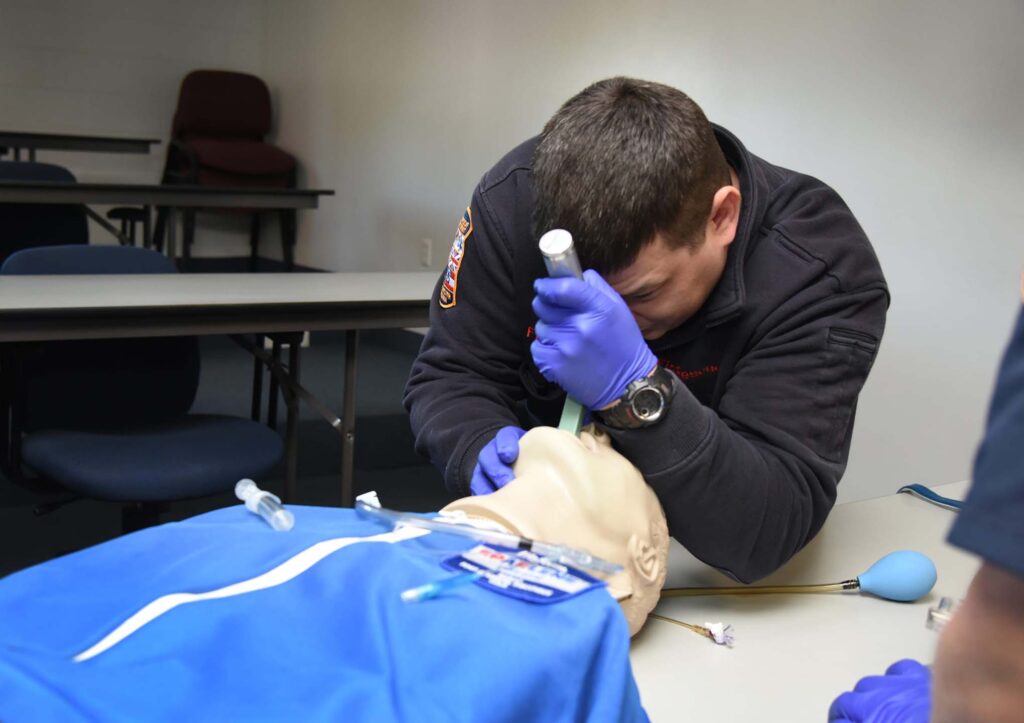
When the Manikin Becomes a Patient
The paramedic had done this before.
During training, the sequence had become familiar. Equipment was checked and placed within reach. The patient was positioned. Preoxygenation was addressed. The video laryngoscope was prepared. The glottic opening appeared on the screen, the tube passed through the vocal cords, placement was confirmed, and the scenario ended.
Then came the real patient.
The room was small. Furniture restricted access to the patient’s head. Secretions obscured the airway while oxygen saturation continued to fall. One clinician prepared suction, another managed medications, and a monitor alarm sounded during the attempt.
The anatomy did not look exactly like the manikin.
It did not feel like the manikin either.
The paramedic now had to decide whether to reposition, suction again, change the approach, stop the attempt, return to oxygenation, or use a rescue airway. There was no instructor who could pause the scenario and no reset button.
There was a patient.
This composite scenario illustrates a problem familiar throughout EMS. A paramedic can demonstrate excellent endotracheal intubation (ETI) technique during training and still have difficulty transferring that performance to patient care. That does not necessarily mean the simulation failed. It may have done exactly what it was designed to do.
Simulation provides repetition, standardization, deliberate practice, controlled difficulty, and safe opportunities for failure and correction. It can prepare clinicians for airway emergencies they may rarely encounter in the field. It is indispensable to modern EMS education.
But it cannot provide everything.
The question is therefore not whether simulation works. It does. The question is what happens when it is expected to do the work of an entire competency-maintenance system.
Why Simulation Became Essential
EMS cannot control when the next appropriate airway patient will appear. ETI is a high-risk procedure, but opportunities to perform it are limited and unevenly distributed. Some paramedics may encounter several appropriate patients while others go months without attempting intubation. Greater reliance on supraglottic airways can narrow ETI exposure further, even when that choice is appropriate for the patient.
Simulation helps compensate for that uncertainty. Unlike clinical encounters, simulated encounters can be scheduled, repeated, standardized, and designed around specific objectives. Educators do not have to wait for the right patient before a clinician practices positioning, suction, bougie use, video laryngoscopy, failed-airway decisions, or post-intubation management.
It also gives agencies an ethical way to prepare clinicians for events that are too rare, dangerous, or inappropriate to seek during patient care. A scenario can include massive contamination, equipment failure, rapidly deteriorating oxygenation, difficult anatomy, an unsuccessful first attempt, team confusion, or progression to emergency cricothyrotomy. These conditions can be created deliberately without placing a patient at risk.
That capability is especially important for high-acuity, low-frequency procedures. Waiting for sufficient clinical exposure is not realistic when the event is uncommon and the consequences of poor performance may be severe.
Research on simulation in paramedic education reflects its broad educational role, while studies comparing simulated learning and clinical placement show that the environments contribute differently to skill acquisition.1,2 The implication is not that simulation should be reduced. It should be used deliberately for the functions it performs exceptionally well.
Standardization Makes Performance Visible
Actual patients are inherently variable. One paramedic may encounter a straightforward airway, another may face contamination and difficult positioning, and a third may have no airway encounter at all. Those experiences are clinically valuable, but they do not provide a consistent basis for determining whether every clinician can meet the same expectations.
A standardized simulation can.
Each paramedic can receive the same patient presentation, equipment, physiologic changes, and operational constraints. Expected critical actions can be defined in advance and performance can be evaluated using consistent criteria.
This allows educators to assess more than whether the tube ultimately enters the trachea. They can observe:
- Patient assessment and the decision to intubate
- Preparation, positioning, and preoxygenation
- Equipment and suction readiness
- First-attempt strategy and technical execution
- Recognition of difficulty and rescue planning
- Team communication and role assignment
- Confirmation and post-intubation management
Standardization turns simulation from a practice opportunity into a meaningful assessment environment. Instead of documenting that clinicians attended airway training, an agency can observe how they manage the same clinical problem under the same conditions.
Standardization must still be used carefully. If clinicians repeatedly encounter the same manikin, room, equipment arrangement, and scenario sequence, they may become proficient at the test rather than adaptable to the problem. The conditions should be consistent enough to support fair evaluation but varied enough to prevent familiarity from being mistaken for readiness.
Standardized Does Not Mean Simplistic
A standardized airway assessment should define what competent performance looks like before the scenario begins. Evaluators need agreed critical actions, observable criteria, and clear performance anchors. Otherwise, two instructors can watch the same scenario and reach different conclusions based on personal preference.
The endpoint also matters. If the evaluation records only successful tube placement, it may reward persistence even when the patient should have been reoxygenated or a rescue airway should have been used. Conversely, it may classify an appropriate decision to abandon ETI as failure.
The measure should follow the clinical objective. Technical actions can be evaluated directly, including positioning, laryngoscope use, tube passage, and confirmation. Cognitive performance requires attention to assessment, indication, anticipation of difficulty, and recognition that the plan is failing. Team performance includes role clarity, closed-loop communication, situational awareness, and use of available resources. Safety performance includes oxygenation, attempt duration, complication avoidance, and timely movement to an alternative.
Evaluator preparation is therefore part of simulation quality. Instructors should review the scenario, scoring criteria, and expected responses before assessing clinicians. Periodic comparison of scores can reveal whether standards are being interpreted consistently.
The objective is not to make every airway decision mechanically identical. Clinical judgment often permits more than one defensible approach. The purpose is to make the standard explicit enough that clinicians know what is expected and evaluators can distinguish reasonable variation from unsafe performance.
Deliberate Practice and Micro-Simulation
Simulation becomes especially powerful when it supports deliberate practice rather than simple repetition.
Performing the same procedure repeatedly does not guarantee improvement. A clinician can rehearse inefficient or incorrect technique unless performance is observed, feedback is specific, weaknesses are isolated, and the clinician has another opportunity to perform the task correctly.
Sometimes the best intervention is not a full scenario. A paramedic who struggles to obtain an adequate laryngoscopic view may need focused work on positioning or blade manipulation. Another may need repeated practice coordinating suction in a contaminated airway. Another may understand the technical procedure but hesitate too long before abandoning a failed attempt.
Frequent micro-simulation allows agencies to address these components in short sessions. Five to 15 minutes during a shift might focus on:
- Equipment setup and checks
- Patient positioning
- Laryngoscope manipulation
- Bougie technique
- Suction preparation and use
- Tube confirmation
- A failed-airway decision
The narrow focus makes frequent practice operationally realistic. The goal is not to recreate an entire resuscitation every day. It is to shorten the interval between opportunities to retrieve and use important skills.
As performance improves, the components should be reintegrated into increasingly complex scenarios. A clinician who practices suction in isolation must later manage it while oxygen saturation is falling, the first attempt has failed, and the team needs direction. Micro-simulation maintains the building blocks. Scenario-based simulation tests whether the clinician can assemble them under pressure.
Feedback Completes the Practice Cycle
The educational value of simulation does not end when the scenario stops.
A debriefing should help the clinician understand what happened, why it happened, and what should be practiced next. Feedback is most useful when it is timely, specific, and connected to observable actions. “Good job” provides little direction. “You recognized the falling saturation but continued the attempt after your stated stopping point” identifies a decision that can be examined and practiced again.
Debriefing should address strengths as well as deficiencies. Clinicians need to know which behaviors protected the patient and should be repeated. An effective first-attempt plan, early preparation of suction, clear team communication, or timely transition to a rescue airway may be more important than the final procedural outcome.
When a gap is identified, the clinician should have another opportunity to perform. That may mean repeating the entire scenario or returning briefly to the component task that caused difficulty. Without reassessment, an agency can document that feedback was delivered but cannot show that performance improved.
This creates a practical cycle:
Perform → Observe → Debrief → Practice → Reassess
Frequent micro-simulation makes that cycle easier to complete. Instead of waiting until the next annual event, educators can address a weakness while the experience is recent and confirm improvement before months pass.
From Tube Placement to Whole-Episode Performance
Airway competency is not limited to laryngoscopy.
A technically smooth intubation can occur within a poorly managed clinical episode. The patient may have been inadequately preoxygenated, suction may not have been prepared, repeated attempts may have continued despite worsening physiology, or post-intubation care may have been incomplete.
The opposite is also true. A clinician who abandons an unsuccessful ETI attempt, restores oxygenation, and moves appropriately to a rescue airway may demonstrate excellent performance even though no tube was placed.
High-fidelity simulation can bring technical, cognitive, team, and decision-making performance together. The scenario begins before the laryngoscope enters the mouth and continues after the airway has been secured or the clinician has appropriately changed strategies.
The first attempt can fail. Oxygen saturation can decline. Equipment can malfunction. A team member can misunderstand an instruction. The patient’s condition can change while the airway is being prepared.
Now the paramedic must do more than demonstrate a psychomotor skill. The clinician must manage an evolving airway emergency.
This progression matters because repeated practice can make component tasks more accessible and preserve cognitive resources for judgment. Varied scenarios can also reduce dependence on a single trainer or memorized sequence. The objective is not the fastest intubation on a manikin. It is reliable performance across the decisions and actions that surround airway management.
Where the Manikin Stops
The strengths of simulation can create a subtle risk. Successful performance during repeated scenarios may be interpreted as proof that the clinician will perform equally well on an actual patient.
It is evidence of readiness.
It is not the whole of readiness.
One advantage of simulation is standardization. One limitation of simulation is also standardization.
Paramedics become familiar with training devices. They learn how far the head moves, where the tongue sits, how much force is needed, what view should appear, and how the device responds when the blade is positioned correctly.
Real patients have not been standardized for training.
Body habitus, mouth opening, neck mobility, dentition, facial structure, tongue size, trauma, swelling, previous surgery, and airway anatomy vary. Even agencies with multiple trainers can reproduce only a limited portion of human variation.
The difference is also tactile. Human tissue moves, compresses, stretches, resists, and responds differently from synthetic material. The feedback associated with manipulating the tongue, advancing a laryngoscope, applying suction, passing a bougie, and advancing a tube cannot be reproduced completely by a training device.
Real airways are dynamic. Blood and secretions may continue to accumulate. Vomiting may recur. Visualization can disappear after it was obtained. The patient’s position and physiology can change while other interventions occur.
Simulation can display falling oxygen saturation, declining blood pressure, or bradycardia on a monitor. In patient care, those changes are happening to a human being. That difference affects judgment, urgency, responsibility, and the consequences attached to every decision.
The most sophisticated manikin remains a representation of a patient.
The Real Test Is Transfer
A clinician may repeatedly demonstrate correct positioning, equipment selection, laryngoscopy, tube placement, confirmation, and post-intubation management in training. Those accomplishments matter. They do not automatically establish that the same performance will occur when anatomy, physiology, environment, cognitive demands, and consequences change.
The question is whether knowledge and skills developed in one setting can be applied effectively in another.2
That is transfer.
Transfer is why simulation should become progressively more variable and realistic. Paramedics should not always encounter the same airway, equipment arrangement, patient position, or successful sequence. They should sometimes work on the floor, in poor lighting, with restricted access to the head, changing physiology, contaminated airways, equipment complications, and unsuccessful first attempts.
Variation forces clinicians to apply principles instead of memorizing the characteristics of a particular trainer.
Yet even excellent simulation reaches a boundary. It can recreate many conditions surrounding an airway emergency, but it cannot turn a manikin into a patient. Successful manikin performance should therefore be treated as necessary evidence within a larger competency picture rather than conclusive evidence by itself.
Why Supervised Clinical Exposure Still Matters
Supervised clinical exposure contributes what simulation cannot completely reproduce: real anatomy, real tissue, physiologic response, human variability, and professional responsibility.
Its value should not be reduced to accumulating a required number of intubations. A well-designed clinical experience allows paramedics to apply previously practiced skills to actual patients while receiving observation and feedback from qualified clinicians. Studies associating intubation experience with success and describing the paramedic learning curve support the importance of meaningful procedural exposure.3-6
Operating-room rotations can provide an important bridge. Depending on the setting, a paramedic may encounter several human airways under the supervision of an anesthesiologist, CRNA, physician, or other qualified instructor. Positioning, technique, anatomical differences, and laryngoscopic views can be discussed as they occur.
The operating room is not the field. An elective surgical patient on an operating table does not reproduce a hypoxic patient in a narrow bathroom. The lighting, positioning, available equipment, personnel, urgency, and physiology may be very different.
That limitation defines the role of the experience rather than eliminating its value.
The operating room is well suited to exposing the clinician to real human airways under supervision. Simulation is better suited to deliberately introducing contamination, equipment failure, environmental constraints, team problems, and rescue decisions. The field ultimately requires the paramedic to integrate both forms of preparation.
No single environment does everything.
Neither Replacement nor Rejection
The correct response to simulation’s limitations is not to reject simulation. EMS would be substantially weaker without it. Nor should supervised clinical exposure be treated as a complete replacement for structured simulation.
Each solves a different problem.
Simulation provides repetition, standardization, deliberate practice, controlled difficulty, uncommon emergencies, and safe opportunities to fail and improve. Supervised clinical exposure provides real anatomy, tactile variability, physiology, responsibility, and guided transfer to patient care.
The strongest educational approach deliberately connects them.
Paramedics should establish technical foundations through frequent practice, combine those skills during increasingly difficult simulation, apply them to patients under appropriate supervision when feasible, and then carry them into field performance. The question after every stage should be what the clinician needs to practice next.
Simulation becomes inadequate only when it becomes the entire competency-maintenance strategy.
The goal is not to use less simulation. It is to use simulation for what it does exceptionally well while obtaining other evidence of readiness from clinical exposure and actual performance.
The next article in this series turns from educational methods to organizational design. It explains how EMS agencies can connect practice, simulation, supervised clinical exposure, field performance, case review, remediation, and longitudinal monitoring into a continuous clinical readiness system.
Because the airway that ultimately matters is not the one waiting in the training room.
It is the one the paramedic has not seen yet.
AI-Assisted Editing Disclosure
Artificial-intelligence tools were used to assist with grammar, clarity, organization, and copyediting. The author reviewed and approved the final manuscript and accepts responsibility for its content.
References
1. McKenna KD, Carhart E, Bercher D, Spain A, Todaro J, Freel J. Simulation Use in Paramedic Education Research (SUPER): A descriptive study. Prehosp Emerg Care. 2015;19(3):432-440. doi:10.3109/10903127.2014.995845.
2. Mills BW, Carter OBJ, Rudd CJ, Ross NP, Claxton LA. Clinical placement before or after simulated learning environments? A naturalistic study of clinical skills acquisition among early-stage paramedicine students. Simul Healthc. 2015;10(5):263-269. doi:10.1097/SIH.0000000000000107.
3. Garza AG, Gratton MC, Coontz D, Noble E, Ma OJ. Effect of paramedic experience on orotracheal intubation success rates. J Emerg Med. 2003;25(3):251-256. doi:10.1016/S0736-4679(03)00198-7.
4. Wang HE, Seitz SR, Hostler D, Yealy DM. Defining the learning curve for paramedic student endotracheal intubation. Prehosp Emerg Care. 2005;9(2):156-162. doi:10.1080/10903120590924645.
5. Dyson K, Bray JE, Smith K, Bernard S, Straney L, Nair R, Finn J. Paramedic intubation experience is associated with successful tube placement but not cardiac arrest survival. Ann Emerg Med. 2017;70(3):382-390.e1. doi:10.1016/j.annemergmed.2017.02.002.
6. Toda J, Toda AA, Arakawa J. Learning curve for paramedic endotracheal intubation and complications. Int J Emerg Med. 2013;6:38. doi:10.1186/1865-1380-6-38.



Dr. Ronald Rivers, DM, MBA, is a retired paramedic and the founder of Sentinel Skills Systems, Inc. located in the San Francisco Bay Area. He recently completed doctoral research at the University of Phoenix examining organizational, training, and operational factors affecting paramedic endotracheal intubation performance. His work focuses on airway competency, skill retention, simulation-based training, and EMS performance improvement.
